
Review: The Drama that went right over everyone’s heads
Photo Courtesy of Pinterest
If Zendaya’s in it, I’m there.
We'd heard about Zendaya and Robert Pattinson shooting a film in Boston long before it ever hit screens, from average people spotting her at a local Tatte to that clip of her throwing coffee on a car going viral on TikTok. I finally got to see it all come to life when I sat down to watch Kristoffer Borgli's The Drama.
Coming into the theater, I expected a romantic comedy with a slight twist. But, as with any A24 film, that twist became something far larger, a revelation I never saw coming: a full-throated commentary on the state of mass shootings in the United States. The film takes the premise of not truly knowing your partner and runs it to its most unsettling extreme, depicting what happens when love, morality, and practicality collide so violently that the entire foundation of a relationship caves in. Just weeks before their wedding, at a venue tasting of all places, Charlie (Robert Pattinson) discovers that his soon-to-be wife, Emma (Zendaya), had planned a school shooting when she was in high school.
I found myself struggling to pick a side. On one hand, Emma had endured heavy bullying and was very much a product of her surroundings. Growing up in the midst of America's mass shooting epidemic, she had been drawn to the aesthetic of guns and violence, an aesthetic the audience itself may struggle to understand. But that is precisely the point. The film asks us to step into the shoes of those who are deeply damaged, emotionally and psychologically, and sit with everything that led up to a moment of unthinkable violence. So often, we hear about these events and cannot fathom how anyone could desire something so monstrous, let alone carry it out. That monstrosity is only slightly softened by what follows: after witnessing a shooting herself, right before she was set to carry out her own, Emma became an activist who spent the rest of her high school career fighting against the very thing she had once planned. Not a justification, but an explanation.
On the other hand, I found Charlie's character deeply endearing, a British man simply trying to understand and stand by the woman he loves. After Emma's confession, the film follows him on a frantic, quietly desperate mission to hold it all together while having absolutely no idea what to do with what he now knows. Understandably horrified, he grows jumpy living beside her, hyperaware of the violence she had once harbored. And yet, at the same time, he is pleading with his closest friends and her maid of honor to still show up to the wedding, justifying her past through the lens of her bullying and even fabricating a more traumatic history to make her easier to forgive. He cannot find his own moral footing, pulled between his devotion to the woman he has spent two years building a life with and the undeniable truth that what she planned was wrong, and that shootings have touched people he loves directly. Every time he tries to sit down with Emma and understand who this person beside him now is, she retreats, telling him it is too hard to talk about. His patience in those moments struck me as surprisingly mature, making her silence on the matter ever more striking.
I thought the film did a beautiful job of capturing the internal conflict of defending someone you are supposed to love while reckoning with the objective truth of who they are and deciding whether to choose them anyway. The cheating scene, where Charlie kisses his coworker and nearly takes it further before pulling back, did not resonate with me at first. But upon reflection, it reads as pure escapism, a desperate impulse to drop everything, walk away from Emma and all the weight she carries, and lose himself in someone who feels uncomplicated, fresh, and untainted. I still think it was cowardly. But I understand it.
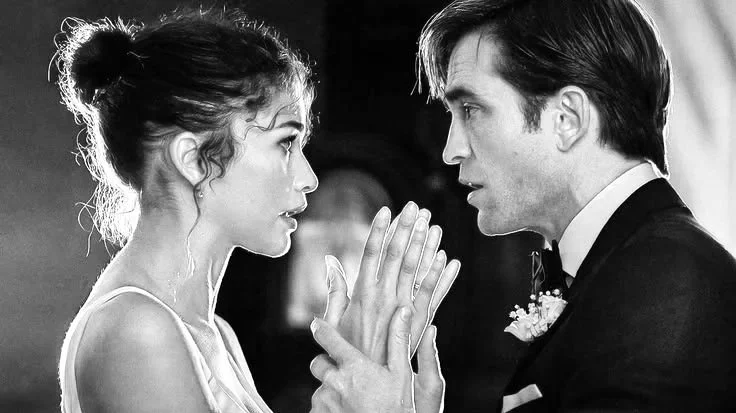
Photo Courtesy of Pinterest
That tension runs through the entire film, and it is one I kept finding myself on the same side of. I understand. But I do not agree. And is that not the question that hangs over us whenever we face any kind of internal conflict with the people in our lives? A falling out with a friend. A political misalignment. A moral one. Someone you love does something you cannot reconcile with who you believed them to be. But you have known them for so long. You let them in for a reason. They were good, in your eyes, up until a certain point. So where exactly do the lines blur, and when do we find ourselves stepping over the moral boundaries we spent years building simply because we've been handed a little more perspective?
Unfortunately, the ending left the whole film feeling slightly deflated. After Charlie accidentally exposes Emma's secret to their entire wedding party, along with everything else, including the cheating scandal, she flees while he trails home after her, bloodied nose and all, the result of a physical altercation that broke out after he confessed to the affair with the wife of a man at the wedding. Defeated and hollowed out, the two serendipitously end up at their favorite diner at the same moment and reintroduce themselves to each other as if they had never met. It is a tender idea, giving Emma the chance to finally open up before they commit to something so enormous again. But the gesture rings a little hollow. Emma never truly reckons with her past, never finds a way through the shame that has kept her silent the entire film. The reset feels more like avoidance than resolution.